

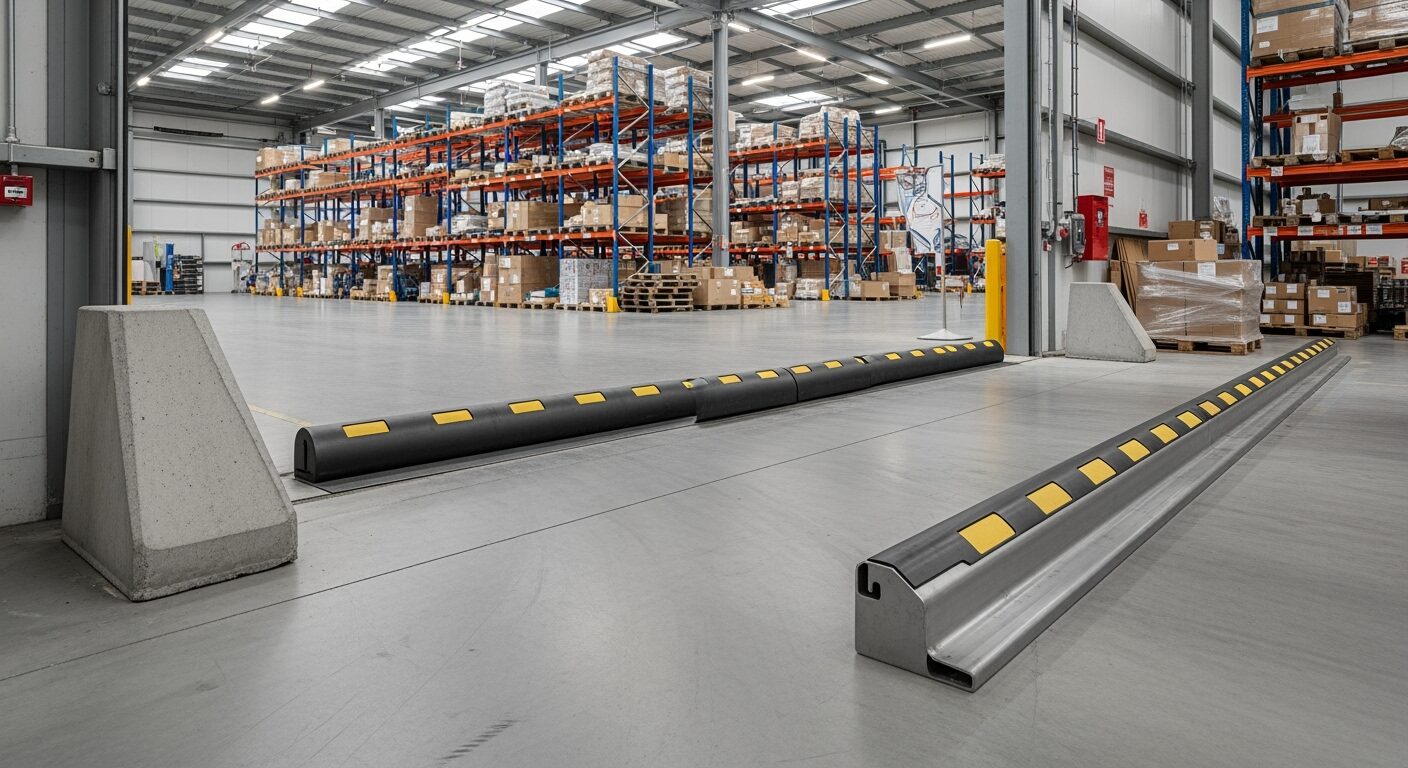
Choosing the right industrial bumpers plays an important role in providing protection and safety in a variety of industrial environments. The text presents the benefits and uses of flexible and steel bumpersand shows the variety of options available, such as rubber, column or ramp variants. Consider which solutions will be most beneficial for your business to improve security and operational efficiency.
Industrial bumpers - applications and benefits
Industrial bumpers play a key role in securing both industrial and warehouse infrastructure. Their primary purpose is to protect against mechanical damage, which is essential for workplace safety. They provide protection for workers, equipment, tools and products, protecting them from damage resulting from potential collisions with vehicles.
They are installed where there is a risk of such incidents, for example on traffic routes, at service stations and in warehouses. Bumpers also protect edges, pillars and storage racks, which translates into greater safety and reduced costs for potential repairs.
A variety of bumpers are available on the market, which can be customised to suit individual users' needs:
- steel bumpers,
- rubber models,
- concrete models.
Their selection depends on the specifics of the site and the protection requirements. It is important that production standards and quality control are at the right level to guarantee the effectiveness of the bumpers. This allows companies to increase the level of occupational safety while reducing the risk of damage to infrastructure.
How industrial bumpers improve safety
Industrial bumpers play an important role in increasing safety by minimising the consequences of collisions in warehouses and production halls. By cushioning impacts, they reduce the risk of damage to equipment and infrastructure, while protecting workers. This, in turn, helps avoid costly repairs and downtime.
Collision avoidance systems such as bumpers effectively support the management of forklift and other vehicle traffic, which is essential in an industrial environment.
In addition, adherence to manufacturing standards is crucial to ensure their reliability and durability.
Types of industrial bumpers and their applications

Industrial bumpers come in a variety of shapes and sizes, allowing them to be perfectly adapted to the specific requirements of each site. The steel versions, valued for their exceptional strength, are often used in areas with heavy traffic, such as warehouses or production halls. Their solid construction effectively protects against mechanical damage, guaranteeing the safety of both workers and property.
Rubber bumpers, on the other hand, are ideal for areas where collisions are inevitable, thanks to their flexibility. They effectively absorb the energy of impacts, which minimises the risk of damage to equipment and infrastructure. For this reason, they are often installed in loading zones and at industrial docks.
Concrete bumpers are extremely durable, making them ideal for protection against heavy vehicles. They are used in car parks and in areas where there is a high risk of mechanical damage.
Thanks to the wide range of models available, bumpers can be precisely tailored to individual needs, increasing their effectiveness in protecting infrastructure. By carefully selecting the type of bumpers, it is possible to optimise expenditure and increase safety in the working environment.
Variety of industrial bumper variants
Industrial bumpers come in many variants, making it easy to adapt them to specific requirements. They are made of various materials such as steel, rubber, concrete or polyurethane.
Steel models stand out for their exceptional durability and are well suited for areas with heavy traffic. Rubber versions, on the other hand, effectively absorb impact energy thanks to their elasticity, making them ideal for loading areas.
Concrete bumpers are highly durable and are therefore used where there is a high risk of collision, such as in car parks. In contrast, those made of polyurethane combine lightness with resistance to damage, making them ideal for dynamic working environments.
Choosing the right type of bumpers helps to protect infrastructure and improves workplace safety.
Rubber bumpers - protection against damage
Rubber bumpers are excellent at dampening impacts, reducing the risk of damage to industrial facilities. Thanks to the flexibility of their material, they can effectively absorb the energy of a collision, thereby protecting equipment and infrastructure. They are of particular value in high-traffic areas such as loading zones or industrial docks, where they improve safety and reduce repair costs. Compared to steel counterparts, rubber bumpers have greater flexibility, making them an excellent choice in dynamic working environments.
Pillar and ramp bumpers - practical applications
Column and ramp bumpers play an important role in ensuring safety in industrial environments. The former are often seen in car parks or factories, where they protect the infrastructure from mechanical damage. Thanks to their robust design, they effectively prevent collisions with vehicles, which significantly reduces the risk of accidents.
Ramp bumpers, on the other hand, are indispensable when manoeuvring vehicles on ramps, guaranteeing stability and protection against uncontrolled movements. This is particularly important in high-traffic areas. Made of robust materials such as steelThey are resistant to damage, which ensures their long-term effectiveness.
Both column and ramp bumpers significantly improve safety at work. Their proper placement and installation can reduce the costs associated with repairs and downtime. As a result, they not only protect physically, but also provide a cost-effective solution for businesses looking to increase operational security.